Показаны сообщения с ярлыком Home Business Magazine. Показать все сообщения

суббота, 9 июня 2018 г.

Hearing is arguably one of our most powerful senses.

Take, for example, how listening to a song is almost like stepping into a time machine. It can take you back to a particular moment in history, perhaps a memorable place or event, and evoke intense feelings.

What’s more, music has also been found to help recall personal memories forgotten by those who have suffered traumatic brain injuries, ultimately proving the power of sound on the human mind.

Businesses can also benefit from tapping into the psychology of sound in their marketing strategy.

Visual branding has, in the past, taken front and center when it comes to an organization assigning the marketing budget. People have become comfortable with its application and are well-versed in how it should – and shouldn’t – be used.

However, the use of audio branding by businesses is also on the rise. Audio branding works as a potent tool for promoting brand recall and reinforcing desired brand values in a customer’s mind. In fact, recent research of 1,000 US consumers by PHMG discovered 67% of respondents believe music is more memorable when used in marketing.

There is a perception that audio branding is just for large, international companies who want a sonic logo or a famous jingle like Intel or McDonalds. Yet, having an unlimited marketing budget isn’t a prerequisite.

Audio works for organizations of all sizes – from one-man start-ups to corporate giants. It helps to create a unified brand image across all customer touchpoints, making sure the organization’s audio presence matches the visual branding to help reinforce the intended company values.

While sonic logos are just one element of audio branding, by far one of the largest applications is on the telephone.

When a customer first calls a business to make an enquiry, they will rely on their sense of hearing to forge an initial impression. If an organization gets it wrong, it could prove seriously damaging. In fact, a previous study by PHMG found 59% of consumers wouldn’t give repeat business to a company if their first call was not handled to satisfaction.

Common mistakes include leaving the customer to listen to beeps, poor-quality music or even silence while they wait on hold. Essentially, this is ‘dead air’ that provides no business value, instead prompting irritation and caller hang-ups. Using audio branding can help transform this period of time into a much more positive customer interaction.

Given the implications of providing a poor-quality audio presence, it is important to follow a best-practice approach when building an audio brand for your company. Working in a similar way to visual branding, business owners should consider what image and values they want their organization to portray then work forwards, choosing sound to match the core ideals.

With music, subtle changes in instrumentation, style, key and chord progression can substantially alter what emotions and brand values are perceived by the listener. For example, a PHMG study discovered strings playing short, sharp notes in a major key made 91% of listeners feel happy or excited. Just changing from major to minor altered the listener’s emotional response, with 81% experiencing a sense of sadness or melancholy.

Often, a business will simply deploy a popular music track over the phone hoping that it will entertain the customer until the call can be answered. Yet people involuntarily attach feelings to songs making it difficult to choose one that will appease everyone. For instance, a track might have been one person’s first dance song at their wedding, conjuring up positive emotions in the listener. For another listener, the same song could represent an unpleasant time, prompting them to hang-up to avoid negative recollections.

Ultimately, how a customer will react to a track is impossible to determine. By creating brand audio from scratch, it not only helps avoid any lasting negative perceptions but by having a totally unique sound, it helps your company stand out from the crowd.

Hold time is unavoidable, even for those working out of their home. In fact, the typical US business has been found to leave customers on hold for an average of 29.83 seconds per call.

Perhaps you’re on the other line or you’re away from your desk and cannot get to the phone in time. Thirty seconds may not seem like a long time but think about how the average commercial is less than half a minute in length and can still influence buying decisions so it is important to consider what callers hear during this time.

Voice and music messages created using the company’s audio brand can help engage and entertain callers on hold while reinforcing brand values. They speak to customers on a more relevant and personal level, boosting service levels by providing them with useful information about the organization in a completely unobtrusive manner.

For example, the messages could cross-sell and upsell products, advertise current promotions or relay company information such as opening hours. They could also enhance the firm’s status as an industry leader by offering advice on related subjects or promoting any accreditations or awards the business may have won.

What’s more, 65% of Americans have said they feel more valued if they hear brand-congruent music and voice while on-hold, improving brand loyalty and providing that competitive edge.

How a company manifests itself across customer touchpoints can be the difference between business success and failure. If there are inconsistencies with visual and audio brands, it could portray the wrong brand image and values and make the organization look unprofessional, prompting customers to take their business elsewhere.

For home businesses, ensuring this is possible needn’t cost millions of dollars. Instead, simply deploying brand-congruent music and voice over their phone system can help unify the brand experience and help companies stand out from the crowd.

The post Audio Branding Gives Businesses a Competitive Edge appeared first on Home Business Magazine.


from Home Business Magazine https://ift.tt/2JEO19S
via IFTTT

One of the best ways for a business to increase sales and growth is to expand overseas. Despite what many perceive as complex local laws, political issues, and cultural barriers, the risk is worth the potential profit increase.

There are obstacles to overcome, but none that can’t be appropriately addressed if you plan correctly.

If you decide you are ready for a move into the global marketplace, this list of do’s and don’ts will help you do so efficiently.

Do Your Research

Research is the most vital component of entering into markets outside your own country. You can learn a lot about the political and economic climate on the internet. Accessing the basic components of importation rules, potential tax issues, and even cultural differences is possible online.

However, there is no substitute for on-the-ground experience. Send in your fact-finding team early. Simple things may not appear in online research. Electricity may not work as well as the tourist and government-sponsored websites suggest. You may find routes to and from your projected place of work or warehouse take much longer than the distances suggest due to local infrastructure and road conditions.

Do Use Professional Translators

Language and translation can be tricky. Many companies have learned the hard way that a brand slogan in English may mean something entirely different, or could be unintelligible, in another language.

You need professional translators, not necessarily tourist operators. A translator who can help with menus, provide a narrative regarding a tourist attraction in English or help you shop, may not have the skills to help you negotiate with property managers, deal with utility companies, or understand the complexities of customs requirements.

Do Employ Locals

Local hires not only speak the local language but can provide a pool of people who have experience working within the local culture. They will understand the various idiosyncrasies of dealing with local officials and local-based clientele.

Do Carefully Screen Local Partners

Ensure you do proper due diligence on any local partners. While there can be legal restrictions on what is possible, there are plenty of companies you can outsource your screening needs to that understand how to work within a country’s privacy laws.

You need sound legal advice to ensure you do not enter into an agreement that will ultimately cost you money and negatively impact your business elsewhere.

Do Choose Your Overseas Locations Carefully

If you do the proper research, you should have a good grasp on where around the world your product or service has the best chance to succeed. Access the risk for not only your product to sell in a market but also the risk to existing personnel who may relocate or visit the area.

Do Leverage Existing Client Relationships

Some of your key customers may be able to help with your global expansion plans. For example, perhaps your customer’s needs are not being met in a country or region. The client may agree to partner with you to help provide the goods or services the customer lacks.

A partnership can also help you more readily grasp the cultural and legal differences of doing business in the area.

Do Consider Local Acquisitions

Choosing to acquire a local company already working in your sector has a lot of advantages compared to starting operations from scratch.

A local company will already understand the culture and have experience working and dealing with the local legal system. You will have an instant, seasoned team you can use to get your product or service out in the local market with minimal infrastructure preparation.

Don’t Underestimate the Costs

The costs and investments necessary to operate in a new market can be significantly greater than expected. Carefully scrub your numbers and budget appropriately. You need to establish the right price point for your product or service, so you have sufficient margins to operate and make a profit.

Don’t Necessarily Expect Your Business Model in the U.S. to Work Elsewhere

Another crucial factor in the global sales and marketing process is understanding how to reach your target market. The distribution model you use in the United States and Europe, for example, may not work in the Middle East.

Sales methods and even products themselves may require modification to reach the new local or regional target market.

Don’t Assume Being an American- or Western-Owned Company Is an Asset

You may need to educate the local market as to the benefits of buying American. Certain countries may not equate “better” with an American version of a type of product or service they have been obtaining for years locally, even if it may be inferior.

Don’t Assume Your Intellectual Property Is Safe

Ensure you get sound local legal advice regarding the protection of intellectual property. Remember that just because a country may have local laws addressing intellectual property rights or is party to an international treaty recognizing intellectual property rights does not mean the laws will be enforced.

The country you operate in may not have the ability to enforce intellectual property laws. You may need to institute your own set of internal protections to minimize the risk.

Don’t Sign Exclusive Distribution Agreements Without a Time Limit

Local distributors often will pressure you into providing exclusive distribution rights for your product or service in the country territory where you want to start up operations.

It may seem like the quickest and easiest way to gain access to a new country’s market, but you may regret it later.

It may limit your growth potential and profit margins, especially if you do not include specific sales goals, marketing requirements, and other specifics to protect yourself.

If you do decide exclusive distribution rights are best for entry into this specific market, limit the term of the contract. Ensure a qualified local attorney approves the contract language.

Don’t Expect the U.S. Embassy to Bail You Out of Trouble

When you are in a foreign country, you are under its rules and authority. If you, one of your employees, or your business gets in trouble, the U.S. Embassy has very limited resources to assist you. The embassy can help you obtain local council and conduct health and welfare checks, but that is about all. The U.S. Embassy cannot violate local sovereignty. The U.S. Constitution does not apply outside the borders of the United States.

The post Do’s and Don’ts of Moving Your Business to Global Markets appeared first on Home Business Magazine.


from Home Business Magazine https://ift.tt/2HsUvUr
via IFTTT

пятница, 8 июня 2018 г.

Using dust-covered commanding combinations is not cool anymore; there’s a way to enhance your user experience with the help of revolutionary apps that will ultimately transform your perception of the use of Mac’s input devices!

Customization of Mac Input Devices

If you wish to become best friends with your keyboards, magic mouses, magic trackpads and give them a new life with awe-inspiring shortcuts and dynamic key sequences, then you might want to entertain the idea of powering them with an appropriate tool. There could be so much more room for maneuvers on your trackpad; it’s almost criminal not to try and create it! Presumably, you are not using your accessories even to the five percent of their real functional capacity. Imagine having numerous talents and only being recognized for one or two of them. It’s not a good look; even unfair in some sense of the word. You deal with Mac products regularly but also avoid using all of the proposed functions because of their complexity and elaboration. Using your devices to their full potential is way easier than mastering the advanced features.

App for Changing Device Performance

Diversify your arsenal of moves with applications like BetterTouchTool. This marvelous app will breathe new life into your gadgets! Let’s take a Macbook for illustration. It’s designed to give you a movement carte blanche! Satisfying navigation is key to the pleasant working experience, and that’s why you need to upgrade the array of options it can implement. Improving the range of capabilities will help you perform even the most complicated commands with a few finger motions.

Such a change will save you a lot of precious time. Working efficiently and doing it with style and grace would greatly dilute the boring, grey and dull hours at the office or home. Mix it up and come up with signature combos that will grant you access to the most used apps, popular bookmarks, relevant pages and frequently visited sites and programs in a few seconds. The BetterTouchTool is versatile and packed with features!

BetterTouchTool has you covered on:

Guide to Creating New Gestures

Platform popularity and a respectable amount of trial days means you have no excuse not to expand the activity of your apparatus. The app is easy to download, and you would only have to drag the icon to the app folder. After the loading process is over, you can get into the action. You must visit the preferences tab to get into the gist of things; that’s where you will be able to train your magic tricks. The main menu shouldn’t scare you. It’s not that crowded with sliders and buttons. As we are determined to modify our devices, we can get straight to the point by selecting a subject of change. Your options will be displayed on top of the window. You need to decide what exactly you want to modify. After picking a device, you need to slide a little bit down and click on the grey button that says “create new gesture”. Nothing troublesome, yes?

Lower your eyes a bit to discover a window that suggests you to choose a gesture and pick an action for the gesture to call for. There are so many options that you will finally realize how limited your past contacts with devices were; how much there is for you to explore and learn. You are free to experiment with your fingers and their sliding on the surface. Setting a middle click is a go-to option for beginners. Try coming up with a multi-finger combo for it. Anything MacOS is capable of is suggested to you. You will run out of ideas before you run out of combinations and gestures; that is a given. The procedure for other devices goes by the same outline. The whole revitalization process with BetterTouchTool will absorb your attention and smarten you up about the machine you are using.

The post How to Customize the Input Device on a Mac appeared first on Home Business Magazine.


from Home Business Magazine https://ift.tt/2JoB3da
via IFTTT

In life, hard-hitting challenges either break or make business owners. For Dr. Ed Picardi, it was the latter. Right after speaking against U.S. Health reform programs Obamacare and Hillarycare, the South Dakota surgeon was charged with multiple counts of a felony that enabled him to be sentenced to prison and be stripped of his medical license in 2013.

Nevertheless, following the thorough review by the Nebraska Medical Board, Dr. Picardi received his medical license back and this time there was no stopping him.

Additionally, the American Board of Surgery reinstated Dr. Picardi’s board certification in General Surgery. The move by the medical board was also a historic one as Dr. Picardi became the only surgeon in the history of the United States of America to be awarded back a Board Certification status after a felony conviction.

It was reported that the board granted Dr. Picardi his board certification status after the medical board came to a conclusion that the felony charges were politically motivated following a comprehensive and broad investigation.

His wrongful conviction took a toll on the financial lives of Dr. Ed Picardi and his wife Sandy. Nonetheless, it did not stop him from doing what he does best and that is giving people a ray of hope.

Right after being reinstated by the American Board of Surgery and given medical license by the Nebraska Medical Board, Dr. Picardi immediately received an urgent call which he described as a sign from God as he was informed of the pressing need of medical missionary work in Africa.

Without a single amount of hesitation, Dr. Picardi packed his bags for Africa and has since been a volunteer of the medical missionary work known as the Samaritan’s Purse.

In spite of huge risks and financial difficulties, the esteemed surgical specialist Dr. Picardi is set to travel to Liberia in May and to Togo, Africa in June to do his missionary work and on patients suffering from malaria, Ebola and Lassa fever.

It can be recalled that numerous doctors died in Liberia in the span of 2014 to 2017 due to the alarming case of Ebola virus but instead of folding up and staying at home, Dr. Picardi is brave enough to take the risk as he is set to do what he refers to as simply God’s work.

In order to be truly happy with our respective lives, Dr. Picardi, who has more than 20 years of experience tucked under his belt, believes that God should be at the center of our daily lives.

Furthermore, Dr. Picardi hopes that he can attain the position of a general surgeon in the near future as he looks forward to changing people’s lives in any way imaginable.

The post The Challenge That Etched Dr. Picardi to Greatness appeared first on Home Business Magazine.


from Home Business Magazine https://ift.tt/2LuS1qW
via IFTTT

Whether you are currently running a successful online enterprise, or are looking to directly take the plunge onto the high street, it would be fair to say that there are a lot of myths doing the rounds about why you shouldn’t take such a route.

There’s no doubt that the internet has opened up a lot more opportunities for businesses and in some ways, it’s far easier, and cheaper, to operate from an online storefront which doesn’t require the annual rent or taxes that brick and mortar establishments require.

However, before you immediately discount the offline option, we have put together today’s guide which scrutinizes some of the truths behind all of the misconceptions that arise from brick and mortar stores such as if they will survive in the digital era. Let’s take a look at the three main ones to balance out the viewpoint, somewhat.

Myth #1 – Payment processing systems are expensive

Setting up a website and accepting payments is something that has become incredibly simple over the last few years. It may have once involved complex technology, but services are out there which can be comfortably built-in to an existing platform. Considering the fact that you don’t need to buy a physical device to facilitate such payments, this is regarded as a major advantage by a lot of business owners.

However, the merchant services industry has come on leaps and bounds in relation to brick and mortar stores as well. These payment processing systems tend to operate on a transaction fee basis, meaning that you will only pay when a customer makes a purchase. This is comparable to many of the systems that are made available to ecommerce stores.

In short, you don’t have to worry about paying for expensive hardware anymore.

Myth #2 – Retail space involves long, costly contracts

Again, this is one of those “once upon a time” cases. Several years ago, retail spaces might have involved long and costly contracts and in truth, if you were to cast the net over certain areas of the country, this might still prove to be the case.

In general, the retail space has become much more flexible though. This is partly due to less competition, with malls having to make space available for “pop up” shops which tend to sit in the walkways and offer shorter-term contracts to businesses. For those who are looking to dip their toes in the water for the offline world, this is something that can work particularly well and obviously doesn’t involve exuberant costs.

Myth #3 – The high street is dying

Finally, we’ve all heard about the so-called “death of the high street” but this isn’t necessarily as true as some sources say. Is popularity dwindling in brick and mortar stores? To some extent, yes. Has it completely vanished? Not at all.

Sure, the footfalls we saw several decades ago might not exist, but that doesn’t mean to say that opportunities aren’t there. It’s all about choosing the right location and working out whether or not your business is suited to a brick and mortar store. In some cases, it won’t be at all, but in others it might transform your fortunes.

The post Debunked: 3 Myths Associated with Brick and Mortar Stores appeared first on Home Business Magazine.


from Home Business Magazine https://ift.tt/2Jw6oOv
via IFTTT

среда, 6 июня 2018 г.

Mobile internet use has risen astronomically over the past decade and you probably don’t even need us to tell you this if you own a mobile phone! People absolutely love the convenience, ease of use and quickness that they get from using their mobile and that is why it is now more important than ever to ensure that your business has a mobile app. Here, we are taking you through the top reasons why your business needs a mobile app and all of the amazing benefits that you will experience from it.

Stay Visible

There have been many studies carried out regarding the use of mobile apps and whether or not they are beneficial for businesses. One thing that most statistics can agree on is that no matter where you are in the world, people are increasingly spending more and more time on their mobile phones. For example, latest statistics show that America, the average person will spend around two hours of their day on a mobile device. Of course, depending on what type of business you have, you may not get the same attraction to your website as other apps such as social media applications. However, what you will get if you are a small to medium sized business is constant visibility. When scrolling through their phone, users will subconsciously be seeing your brand all the time and this is a great way to stay connected to your audience and add value to your brand.

Improve Your Customer Experience

One of the great things about having an app for your business is that you can massively increase your customers’ user experience. If your app can make it easier for people to buy your services or goods, this will then generate more traffic to your business and conversions! An app that provides a smart and rewarding user experience is sure to become extremely popular amongst its target audience.

Use It for Free Promotion

Once your mobile app is built, it can be used as an amazing promotional tool. After your initial investment, you can then essentially start promoting your business free of charge! What’s more, if you want to offset the initial costs, you can always take web development courses to help you understand the process of building an app. These types of courses are offered by Red Academy and are taught by experienced industry professionals who will prepare you to code websites plus build web and mobile applications!

Go Global

One of the biggest benefits of a mobile app is that you can take your small, local business global! If you think your business could sell its goods or products worldwide then a mobile app is the perfect way to expand your market without having to make any major investments. Mobile apps and the web have provided a platform that allows small businesses to become a global success overnight. For example, if you have a local shop that produces handcrafted goods, you can then have these products reach people all around the world through the mobile app.

Integrate All Your Business Channels

An app can quickly become synonymous with its digital identity and after it starts to gain traction and engagement from customers it can then become a hassle-free way to interact and buy from your business. An app can easily become the main business channel and it can work as the main hub for all your channels. This can provide your business with amazing branding, better business processes and a customer-centric marketing campaign. Furthermore, with a mobile app you will have total control over every channel internally.

Make More Sales with an App

For many small businesses, the initial investment in an app, whether this is time building it yourself or paying a professional, is deemed not to be worth it. This is also usually despite all research pointing towards apps creating growth in businesses and driving sales. However, if you are just looking to start off by creating a simple app, this does not have to cost you a fortune. You can have an app built on a very competitive budget that provides an easy-to-use interface and quick engagement.

Beat Out Your Competitors

Last, but certainly not least, is that for many small businesses you can gain a huge lead over your competitors by providing a mobile app. Whilst your app will be up and running and making lots of big sales, your competitors are most likely still going to be debating whether or not an app is a good idea for their business. Having an app gives you an instant edge over your competitors, giving you the competitive lead.

The post Why Your Business Needs a Mobile App appeared first on Home Business Magazine.


from Home Business Magazine https://ift.tt/2xJjDqo
via IFTTT

суббота, 2 июня 2018 г.

Employer Identification Number (EIN) is a nine-digit number issued by the Internal Revenue Service (IRS), an agency responsible for collecting taxes and enforcing tax laws in the United States. The IRS uses these EIN numbers to track any financial transactions that businesses, partnerships, trusts, estates and individuals carry out for the purposes of collecting taxes. You cannot run a business in the US without this number. If you are having problems applying for it, here are five simple tips that can make the application process easier for you.

1. Choose One Mode of Application

There are various methods you can use to apply for the EIN. You can apply online, via email, by a phone call, by fax or just fill out a hard copy and present it to the relevant offices. It is important that you only submit your application once. Submitting the application using more than one method won’t make it faster, it will just cost you more due to duplication. That’s because you may be required to repeat the process all over again, wasting more time.

2. Identify the Fastest Possible Method

The time required to finish the application process varies from one mode to another. Using fax will take you about four days. Using email will take about four weeks, while applying online can be just a matter of a few hours. If you are working within a set time period, then it would be better to apply by using a website. Check one out at federal-ein-application.com/irsein/ss4-online/ and fill out the form; it is an easy process.

3. Ensure You Have All Your Details and Documents Ready

Have all your documents and details ready before you settle down to fill out the application. If you are filling out the application via phone or online, it is paramount that you have all the required information, such as the type of business, business name, name of the owners or members and location, among other information. You will not have an opportunity to save your data to continue at a later date. This means that if you do not have the required data, then you will be forced to start the process all over again.

4. Strictly Follow the Instructions

The application process is designed in such a way that you follow a step-by-step process to ensure that you enter everything required correctly. You are also allowed to check the definitions of terms in case you want to clarify any information. The process is simplified in such a way that it allows you to only enter the information that you are sure about. Take your time to ensure that you do not enter any incorrect data.

5. Go Through Your Application

When you are finally through with filling out the application, take some time to go over your form to verify that all the information you have entered is correct to the best of your knowledge. Check also to ensure that you have not left any place that requires filling empty. Check your contact details and all other relevant information. When you are content with the application, you can then submit to the relevant authorities and wait for their feedback.

The post 5 Tips to Applying for a Federal EIN Number appeared first on Home Business Magazine.


from Home Business Magazine https://ift.tt/2sAiU4H
via IFTTT

The first established business I started was a brick-and-mortar fast moving consumer goods business. My business premise was far away from the house, and I spent more than an hour every day commuting.

Soon after starting, I applied a couple of marketing strategies I learned from Brian Tracy’s The Psychology of Selling and in a few weeks my turnover had increased by more than 100%.

Everything seemed to be perfect.

Exactly one year later, however, a fire broke out in my business premises and gutted everything. Unfortunately, I didn’t have any insurance cover. The reality of life suddenly dawned on me. I practically realized that I could lose everything I had worked for all my life in a single day.

I didn’t need a soothsayer to tell me that it was time to look for a better alternative.

I teamed up with one of my best friends, and we started our home-based business; a blog.

Presently, my story has changed. I currently run a content marketing firm from the comfort of my home. I don’t make millions of dollars, but I make more than I could have ever imagined.

Starting and boosting a home-based online business is one of the best business decisions I have ever made. So far, I have loved every part of it. The reasons below are what convinced me that a home-based online business is the best shot for me.

1. The comfort that comes with working at home

As I write this, I am sitting on my couch with my laptop on my laps, typing away. I woke up a few hours ago and brushed my teeth. And without having to take my bath or dressing up, I picked up my laptop and started working, and loved it. I don’t have a boss breathing down my neck, and I don’t have to worry about coming to work late. I own my own space.

2. I save the time I would have spent commuting

Back in the days when I still had to go to work, I always came back tired. I was productive, but I noticed that the extra one hour I spent commuting usually stressed me out. Not just that, the time I spend getting ready to go to work and closing from work, is actually a lot.

Working from home has changed all that, as I get to use the time I would have spent commuting to do something more productive. This means that I have the chance to put in more work at times. Other times, I could invest it in taking a course or spending time with my loved ones.

3. The ability to work remotely

One of the things I enjoy most about my present job is that I can be anywhere in the world. So long as I have internet access, I can still do my job and communicate with my staff and clients.

Presently I have a good number of clients who regularly need my writing services. I have never met any of my clients so far by the way. Everything is done through emails.

Equally, I have a fully functional and productive remote team. I mean, 80% of my staff live in different cities from the one I do, and they still deliver exceptionally. That’s amazing! All my staff and I live and work in Nigeria, but having a home-based online business made it possible for me to do business with people I would never have met ordinarily.

4. Lower expenses are incurred

Back when I had my office outside my house it meant I had to pay rent and utility bills twice. Also, I had to spend some money commuting, and this also comes with its own stress. All the extra costs I incurred convinced me that it was time to stay home and work. Working from home saves me from all that. I get to save more money too.

5. Opportunity to be anything I wanted

As a home-based online entrepreneur, one of the first things I did was to register on Upwork and on fiverr. The good thing about job websites is that there is no watchdog saying, “Hey, you can only be a graphic designer. You cannot and must not try your hands-on programming unless you live in Atlanta.”

Ordinarily, I would not get access to some jobs in the real world just because of my location. But in the online world, what matters most is the fact that I can deliver and meet the expectations of my clients. And guess what? Nobody cares if I work on top of my bed in my pajamas, or not.

6. Flexible work schedule

When I had an office, I had to be at my business premises by 7:30 am every day and get back home 12 hours later. This meant that though I was an entrepreneur, I wasn’t really in control of my time or my schedule. My customers were.

Presently my home-based online business gives me the flexibility to work whenever I need to. Because I work in a different time zone from most of my clients, it means I don’t have a fixed work schedule.

For instance, I wake up very early. And because I am in control of my time and I have a flexible work schedule, I can afford to write an article of 2000 words even before the average person wakes up by 6:00 A.M. to start their day.

The post 6 Reasons That Made Me Start a Home-Based Online Business appeared first on Home Business Magazine.


from Home Business Magazine https://ift.tt/2srPZAF
via IFTTT

A business can thrive or decline depending on the type of payment processor that is used. Before settling on a particular payment gateway, you have to ensure that it presents a secure way of requesting payments from your clients. Selecting the right gateway will require a merchant to carry out some background research about the payment processor since it can be hard to tell which company is the most convenient. This is certainly the case considering the numerous options on the market currently. This having been said, here are the top three things to look for in a payment processor.

1. Fees and Pricing Tier

The majority of payment gateway companies are attractive in that they offer low fees and people quickly rush to them without checking whether the company has hidden fees or not. Companies may charge differently depending on a transaction or even by the type of card that is used to make payments. For instance, credit card payment processors charge a higher rate for non-qualified cards compared to qualified cards. The higher rates are because customers get rewards for the purchases they make. It is, therefore, necessary to go through a payment processor’s website and get updated on the fees charged. Some companies charge either per transaction or monthly while others charge fees for every transaction and still charge at the end of the month. It’s better to target payment processing companies that offer minimal fees while still being reliable in terms of service quality.

2. Flexibility of Payment

Customers may have particular and preferred modes of payments. When choosing a payment processor, it is advisable to ensure that you consider the purchasing needs of your clients. Choosing a payment gateway that offers a variety of payment options can significantly boost your business. You can also choose to have an option for a payment plan for your clients. A payment plan would be letting customers pay for a particular product or service within a certain time period. With some of the best payment processors, you can even allow your clients to make payments in bitcoins or any other cryptocurrency.

3. Fraud protection

Cases of fraud have increased over the past few years. A merchant in a store may find it difficult to tell whether the client using a card to pay for goods is the owner of the card or not if they do not have a payment processor that efficiently identifies fraudulent activities. Fraudulent acts can destroy a business. In some cases, customers may claim that they didn’t receive their purchases while in fact, they had. You can have your fraud protection system in place; it is costly both to install and to maintain. To maximize profits, you should ensure that the company has security policies in place to protect you from being linked to fraudulent activities. The plans should also ensure that the entire process adheres to the PCI requirements.

Choosing the right payment gateway adds a competitive edge to a merchant. The effectiveness and efficiency of the payment process play a critical role in the entire process. Before rushing to select one, be sure to verify that the payment processor is affordable in terms of their fees and that they don’t have any hidden charges. Do not forget about the fraud protection policies and flexibility of their payment options.

The post The Top 3 Things to Look for in a Payment Processor appeared first on Home Business Magazine.


from Home Business Magazine https://ift.tt/2HcyXLE
via IFTTT

Technological innovation comes with pushes for changes in the way people do business, and in an effort to remain relevant you may need to incorporate a new design. Whether revamping your website or the logo for your business, coming up with a design that conforms to current trends could be challenging and that is why many businesses prefer to hire professionals who can help them. If you are coming up with a new design project, here are some compelling reasons to embrace crowdsourcing for the project.

The power of collaboration

The biggest benefit of crowdsourcing is that you can leverage networking capacities to bring on board designers to help you complete your project on time. Instead of taking a month working on the project, you can get a team on board that will help you to do it in about two weeks. You can identify the best professionals in design to ensure your team is composed of people who can deliver results that will make your brand shine. By building a solid team of highly skilled individuals, the business will benefit from the different ideas that are shared by the professionals, and this could improve your products.

Efficiency

Crowdsourcing also guarantees efficiency. Unlike working with in-house professionals who may not possess all the capacity you need to design well, you can find professionals who have diverse skills without having to hire them for an in-house role. It allows you to quickly complete a project and once you receive the services, the contract could be terminated or renewed if you have a new project.

You can participate in crowdsourcing platforms online that allow you to post your requirements, then the right professionals will apply to help you with the specific project. These platforms also have experts who help to review the work of the designers before it is submitted to you, and this ensures you are given the best quality.

Cost-effectiveness

Since you are not hiring a team that expects a regular salary, you only need to pay for the specific project then terminate the contract. You can also find designers who offer discounted rates that will help you to save money. Most of the online platforms on which you can find professionals allow experts to bid, then you are able to pick the best based on rates and proficiency. You can get rid of overhead by hiring on a freelance basis only when you need some designs to be made.

Better creative environment

Working with an individual designer is a challenge because the person may decide to compromise a project based on their understanding. With crowdsourcing, there are many designers who come on board with different ideas. Most of the designers understand the company and will create a design that is relevant to your needs based on their creative powers.

Improve brand awareness

Using crowdsourcing is also a perfect way to connect with relevant audiences. It gets people excited and could be used as a way to earn positive publicity that your business needs to excel. Create a contest and let the information be shared across different online platforms. This will create awareness that can also be used as a way to promote the business.

Setting up a logo design contest through a crowdsourcing project could help you to create a perfect logo for your brand. This is an exercise that brings together expert designers who present their creative ideas before you so you can choose what you think is ideal. Crowdsourcing allows you to finalize your design project faster and is also affordable.

The post Why You Should Crowdsource Your Next Design Project appeared first on Home Business Magazine.


from Home Business Magazine https://ift.tt/2srVcIN
via IFTTT

These days, more people are rethinking the idea of work, and one way they do this is by starting home-based businesses. This is especially true for Millennials because they experienced a tough job market following the 2008 recession. As a result, they turned to entrepreneurship as a way of establishing financial stability. Thanks to the Internet and the smartphone, it is now easier to create and maintain successful home-based businesses.

You Cut Down on Commute Time

When you have a home-based business, you save money and time by eliminating the commute time. This is the same for telecommuters who work for businesses remotely, and it would be wise to let your employees work from home as well. With the money you save, those funds can go towards long-term goals. These might include family vacations, your kids’ college education, giving to those in need and retirement planning. When you don’t have to commute, you have more time to take on new projects.

Your Hours Are Flexible

Flexibility is at the top of the list when you consider the benefits of working at home. You don’t have to be a workaholic at the expense of your family and other obligations. If you are homeschooling your kids in the morning, you can work on assignments at night after everyone goes to bed. Some home-based business owners set specific work hours and let family members know in order to maintain a balanced routine.

Your Creativity Soars

Another advantage of a home-based business is that you can be as creative as you’d like. You don’t have to worry about a boss rejecting your new ideas because you are in control of the projects you’re interested in. You can be excited about your workdays instead of feeling limited by the restraints of a regular job.

Tips on Starting a Home-Based Business

The first step is to take stock of your abilities and interests. As you look over them, think about how you can turn them into a successful business. If you have a passion for children, you might decide to open a daycare at home. How to register a business is something you’ll need to know, and it can be different state by state. Consider whether this business would interfere with your family life. Then you’ll need to ask yourself if there is adequate demand for the business you want to start. Research your idea and whether there is a strong market for it. This helps you figure out if you can earn a decent profit. The final step would be to create a plan and marketing strategy that works.

Pitfalls to Avoid

Some home-based business owners fail to see the need for additional funding for their ventures. While you can operate the business using part of your current income, there will come a time when you’ll need to seek outside capital. You’ll want to research different sources of funding while in the initial stages of your business. Another pitfall is not having a plan that allows you to balance working from home with family responsibilities. Lack of organization can also happen with home-based business owners.

If you put in the effort and are optimistic, your home-based business can thrive. It also helps to seek out mentors who will be able to offer guidance in starting your business. Don’t expect immediate results because there are times when you will not earn profits. The key is to be consistent and educate yourself on how you can improve. Most importantly, view your business as an extension of your personality, abilities and values.

The post How Home-Based Business Paved Its Way to Being the Modern Workplace appeared first on Home Business Magazine.


from Home Business Magazine https://ift.tt/2sAbajp
via IFTTT

Summer is just about to make its arrival! In addition to revamping business strategies and decluttering your office, now is the perfect time to become aware of all the new ways that con artists are trying to scam hardworking company owners out of their money. Below are new small business scams to be aware of and ways to keep your info and money safe.

Email phishing attacks. 

This occurs when a hacker impersonates a legitimate company in an attempt to steal a person’s personal information or their login credentials. The employee will open the email, in addition to attachments or links, and unknowingly, a virus will download onto their system. This virus is designed to spread to the employee’s computer collecting personal information such as social security numbers, bank information, and credit card information.

Educate your employees on the dangers of opening emails from unknown sources. In addition, instruct them not to click on links or open attachments from unknown sources. It is also imperative that company computers have anti-phishing software installed.

Attacks of ransomware.

This is a type of malicious software where a computer or network is infected with a virus that encrypts data. There is a threat to the victim that their data will be made public or they will no longer have access to the data if they don’t pay a ransom. If the business does not have an effective way to recover the data, it may decide to pay the ransom which could range upwards of thousands of dollars. Paying this ransom doesn’t guarantee the company that its data will be returned. For a small business, losing their data could mean closing their doors. Cybercrime costs small and mid-sized businesses nearly $75 billion a year.

Fake small business awards.

A scammer will call a small business owner, disguised as a representative from a company, and tell them that their company has been selected to receive a small business award. The caller may also ask that a fee for an annual membership be collected in order to have the company featured in a publication, most often in the business field. Alternately, the business owner may receive a letter stating that their company has been selected to receive an award that only a small percentage of business owners have received.

The business owner’s first step is to research the company and confirm that the company is legitimate. They should never send the company money when they request an up-front fee for receiving the award. Furthermore, they should never pay the fee using a credit card over the phone.

Fake office supply purchase.

Supply scammers will try to manipulate a small business if they think that there’s a chance that they don’t have a purchasing department or that the employee that places the orders is not the same employee who pays the invoices. A business may receive a shipment of supplies that they did not order. The invoice is attached. The business owner decides to pay the invoice thinking perhaps their purchasing personnel ordered the supplies.

In another scenario, the company receives a call from a supplier stating that the call is only to confirm an order. If the business owner states that they didn’t place an order, and that they refuse to pay, the caller will claim to have audio recordings that prove that the order was placed. According to the Federal Trade Commission, if a business receives merchandise and no one at the company ordered it, the merchandise need not be returned, and the vendor can’t come after the business for reimbursement.

Fake tech support.

A hacker may contact a small business employee, posing as a tech support personnel, and state that they need the employee’s computer access in order to fix a problem with their computer. However, they are not tech support and there is no problem to fix. Hackers have also been calling small businesses, posing as employees of the Global Privacy Enforcement Network, and telling the employee that their email has been hacked and has been sending fake messages. The hacker explains to the user that if they don’t give them access to their computer, legal action will be taken. Educate your employees to never release access to their computer to someone calling from outside the company and claiming they need the access in order to fix the employee’s computer.  

Justin Lavelle is the Chief Communications Officer for BeenVerified, a leading source of online background checks and contact information. It allows individuals to find more information about people, phone numbers, email addresses, property records, and criminal records in a way that’s fast, easy, and affordable. The company helps people discover, understand, and use public data in their everyday lives. https://www.beenverified.com

The post Must-Know Small Business Scams To Prevent This Summer & Beyond appeared first on Home Business Magazine.


from Home Business Magazine https://ift.tt/2kHoIWE
via IFTTT

Success in retail business depends a lot on how well a merchant can create personalized shopping experiences. In this regard, accurate segmentation and handy technologies are key to providing relevant value propositions to different customer groups in a web-store, be it on Magento 2, WooCommerce, or any other platform.

To stay relevant and competitive, merchants should acknowledge trends in customer behavior so as to timely improve their targeting strategy. A recent Global Consumer Insights Survey by PwC revealed some interesting changes in customers’ shopping preferences.

For those who are short on time to read a full report (though we highly recommend it), we came up with 5 important takeaways that can influence e-commerce customer segmentation in 2018.

1. Customers seek experience

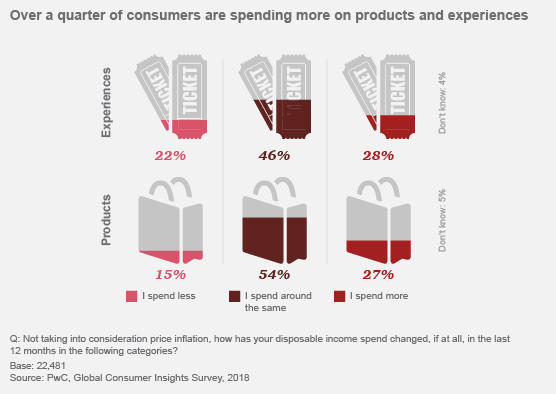
PwC asked consumers about their spending on experience and products and got the following results:

Over the past 12 months, 28% spent more money on experiences and 27% increased their spending on products. 46% of respondents said that they spent the same amount of money on experiences and 54% of them neither increased nor decreased spending on products.

Overall, PwC found out that people become more confident about their ability to afford extra products and experiences and plan to increase their purchases in the future. This is definitely a positive sign for merchants. At the same time, customers begin to value experience more and savvy retailers can exploit this trend. How?

Merchants can create stories and offer not just particular products but entire stories instead. For example, the Spearmint Love succeeded with it when they created a photo-story showcasing a complete outfit instead of featuring just a photo of a shirt or shoes. Mothers, their target customers, came back to the web-store and bought everything that was in the picture. That sounds promising, doesn’t it?

2. Customers go mobile but still value physical experience

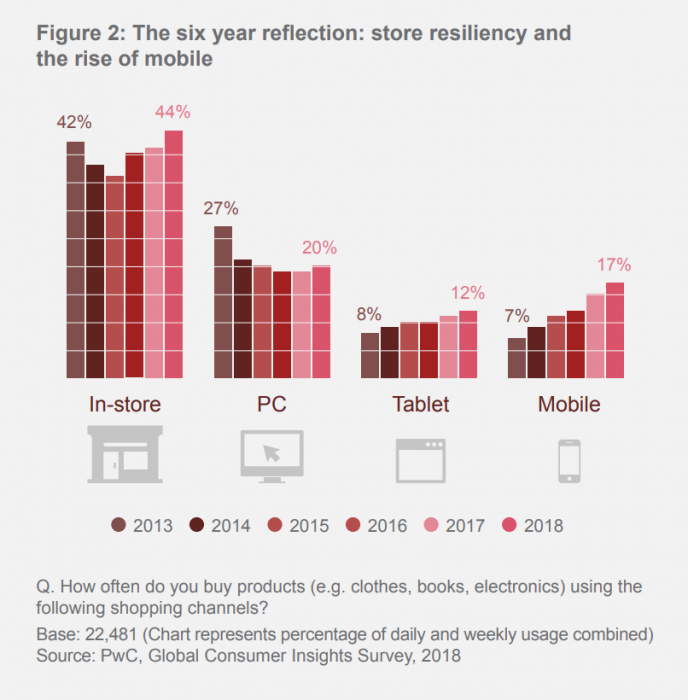
PwC analyzed changes in the preferences for buying channels from 2013 to 2018. Though with a decline in 2014-2015, physical shopping is now gaining popularity. Customers consider shopping a pleasant sensory and social experience rather than just a reasonable act of buying something they need. At the same time, shopping via PC declined from 27% to 20%, tablet buying rose slightly, from 8% to 12%, and mobile-based buying more than doubled, from 7% to 17%. In the report, PwC predicts that the mobile channel will soon surpass personal computers.

Taking into account these shifts, merchants can start paying more attention to customers’ preferred communication channels and adjust their online activity accordingly. So, retailers can test their web-store and marketing emails once again to make sure they are equally convenient for browsing on mobile devices and PCs. They should consider the size and UI of messages and pages as well as users’ average connection speed and viewing environment to deliver an optimal shopping experience via both channels.

3. Customers prefer trusted brands and their trust depends on SNs

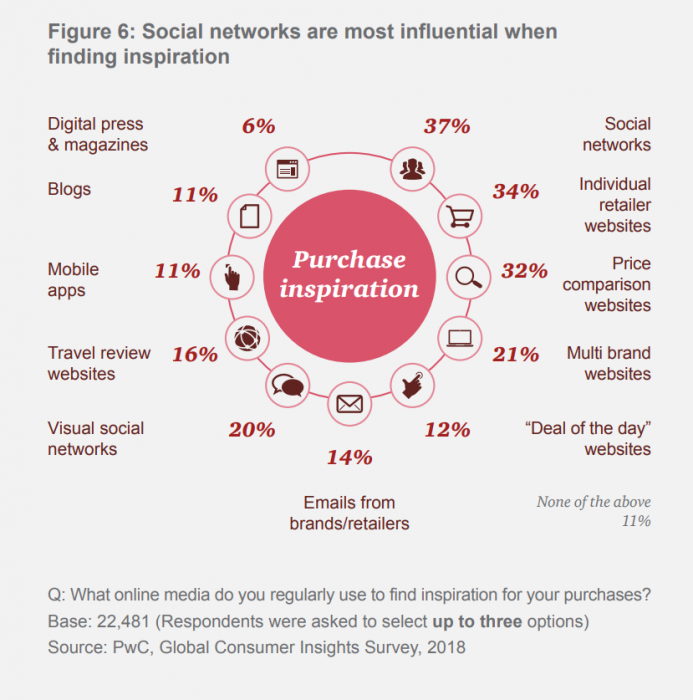
PwC states that trust in the brand is the third factor after price and stock availability that influences customers’ purchase decisions. However, even though trust matters a lot, customers rely more on other people’s opinions than on branded messages. 37% of respondents named social networks as the source that motivates them to buy particular products. At the same time, individual retailer websites and price comparison websites ranked second and third, while emails from brands per se got only 14% of votes.

This means that opinions on social media, which are beyond merchants’ control (unlike ads and promos), considerably influence customers’ purchase decisions. While retailers start communicating with customers via SNs, they should keep in mind that shoppers trust social media only when they feel the authenticity of opinions.

Putting consumers’ interests first is the only winning strategy in this regard. For example, the Patagonia brand did it perfectly by showing their eco-friendly and family-oriented values through marketing campaigns on social media.

So, analyzing core values of customers, participating in or even creating social communities around relevant topics will help retailers build trust and brand awareness much better than branded emails or ads on websites.

4. Customers want relevance and disapprove of spying

PwC found out that 40% of customers are fine with retailers tracking their data, shopping patterns, and purchase history. Even more, customers expect that merchants will use this information to deliver relevant offerings. Yet, the study also says that customers feel less comfortable when retailers track their location as well. Only 34% agreed that they don’t object to retailers knowing their physical locations and communicating with them via mobile when they pass by.

So, while geolocation may seem an excessive measure for some customers, merchants can concentrate on psychographics-based segmentation that includes personality traits, values, opinions, interests and so on. The golden rule is to get to know customers but not surveil them.

5. Customers are ready to pay for fast delivery

Good news for delivery partners. The Global Consumer Insights Survey shows that more than 40% of online customers will pay more for same-day delivery and 24% of respondents will accept an extra charge for getting their order within one or two hours.

Also, PwC discovered that customers over 65 prefer a delivery at a specific time slot.

So, our takeaway is to reconsider delivery as a service and offer more convenient delivery time options for customers to choose. Customers understand that fast shipping requires extra logistics effort and will accept higher prices for that.

Conclusion

Penetration of technologies in people’s lives, for sure influences customers’ preferences and shopping habits. Customers begin to value experience more than tangible products. They appreciate their time more than ever and thus are ready to pay extra for a quick delivery and provide their data to get relevant offerings.

Though the wisdom of the crowd stays as important as it was dozens of years ago, it has also undergone a digital transformation. Today customers go to social networks to check what other people think of particular brands and products. This way, SNs offer merchants an opportunity to add a human touch to their communication with customers and build trust in their brand.

A stable popularity of brick-and-mortar shops shows that digital shopping channels can only complement a pleasant physical experience that customers get in stores but can’t replace them completely.

To sum it up, only the merchants that are ready to adapt to shifts in customer behavior and focus on customers’ experience will survive in a competitive environment.

The post 5 Takeaways from PwC’s Global Consumer Insights Survey 2018 appeared first on Home Business Magazine.


from Home Business Magazine https://ift.tt/2kJfs4A
via IFTTT

Altcoins Like DasCoin, and the Search for the Ideal Cryptocurrency

The cryptocurrency market is experiencing a mini gold rush of sorts in recent months, with buyers sifting through the quickly growing number of publicly trading cryptocurrency options on the market in search for the ideal investment. The days where Bitcoin was the first and last word in terms of options are long gone, with solid alternatives popping up in the form of altcoins like DasCoin and others.

Searching for the ideal altcoin may seem a difficult task, but nothing could be farther from the truth. With the internet and active cryptocurrency communities at your disposal, it is now easier than ever to find the information you need to make educated decisions and sound investments when choosing your ideal altcoin.

Below are some of the salient points to consider in your search for the ideal altcoin, and why the application of such will lead to better choices when selecting the cryptocurrency that works the best to accommodate your needs.

Altcoin Shopping: Finding Options like DasCoin with Promising Trends

The first thing to look for when searching for the ideal altcoin is relevant data. You will want to look for trends in value and user base that span at least two years, ideally more. What this data will show you is how the altcoin you’re looking at is faring over time, whether its price fluctuates heavily, whether it spikes in one direction or the other, and most importantly, whether other people are interested in it.

Regardless of value, a solid user base can be seen as a more important factor when considering a good Altcoin like DasCoin. High value but a lack of users can be a sign of inflation or a lack of supply, or even mismanagement in terms of managing circulation or supply of the cryptocurrency, which can be a bad omen in the future. Overall, you’re looking for a lot of users, and a steady trend of increasing value over time.

Active Developers and Solid Innovation

Another thing to look out for in your search for the ideal altcoin is how active the developers or management are in the industry. Many altcoins out there can be shell currencies, holding value and still in active circulation, but without any new developments or new batches of currency circulating, meaning that a finite amount exists, pushing value up, but without any hope of future growth of new developments to address any issues that might come up. An active development team with community management is a sign of both stability and trust, key things to look out for in your search.

Using Data to Your Advantage

Overall, your search for ideal altcoin finds such as DasCoin are dependent almost entirely on your gathering and interpretation of data. Finding accurate sources is key to making any final decisions. As for what to look for, the criteria is quite intuitive, in that you want an altcoin that increases in value over time, and has an active community and developer base to address any concerns, and to guarantee that management is sound and continuing. If you keep all this in mind, and with but a little patience and sound decision-making that perfect altcoin is just over the horizon!

The post Ways to Spot a Good Altcoin like DasCoin appeared first on Home Business Magazine.


from Home Business Magazine https://ift.tt/2Jt0Yn4
via IFTTT

пятница, 1 июня 2018 г.

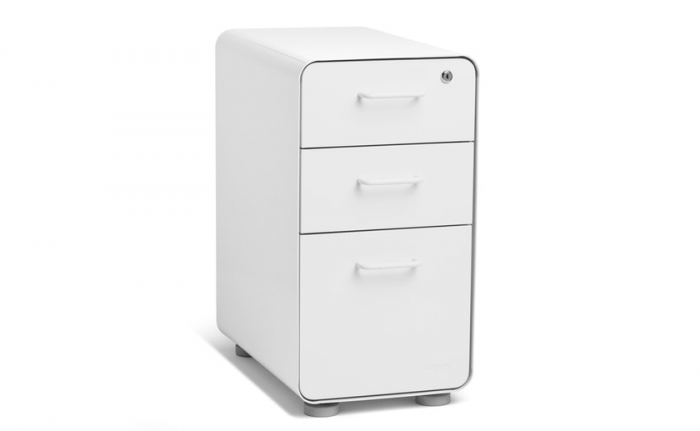
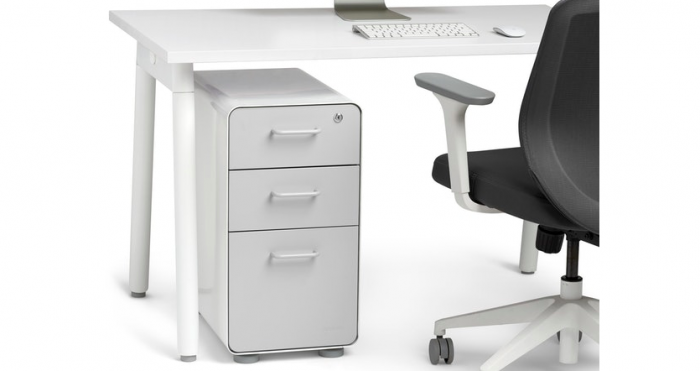
From client proposals to employee reports and licensing agreements, there are so many important documents that home business owners need to keep safe and secure. For all entrepreneurs looking for a new cabinet for their home office, Poppin’s classy and design-forward Slim Stow 3-Drawer File Cabinet will keep files safe while adding a dash of contemporary elegance to the workspace.

The perfect size for narrow 47″ desks, this classy cabinet features a powder-coated steel construction with a matching painted steel interior to keep files safe. All three drawers are painted on the inside and outside and can be secured with just one lock to give entrepreneurs peace of mind in knowing the contents inside are private. It is equipped with two handy utility drawers and adjustable drawer dividers to keep everything organized.

This sleek cabinet will add a modern, minimalist aesthetic to any home office. Entrepreneurs will also appreciate that it comes with two keys in case one goes missing. For business owners who can’t have any distractions, the cabinet comes fully assembled (even the handles!) so there is no need to take time out of a busy workday to set it up. Available in White, Light Gray, and Black, it retails for $239.99 at poppin.com.

Contact: shannahch@gmail.com

The post Organize Your Important Documents with Poppin’s Stylish & Secure Slim Stow 3-Drawer File Cabinet appeared first on Home Business Magazine.


from Home Business Magazine https://ift.tt/2xGu7H5
via IFTTT

It is easy to experience a slump in motivation during the summer, so now is the perfect time to fill your office with essentials that will help inspire and boost your productivity. If you love listening to music while you work, there is an all-new, multifunctional speaker that will help you always stay on task: the stylish Como Audio Solo Speaker. With this speaker, you can enjoy songs from FM, Spotify Connect, Bluetooth technology, and more!

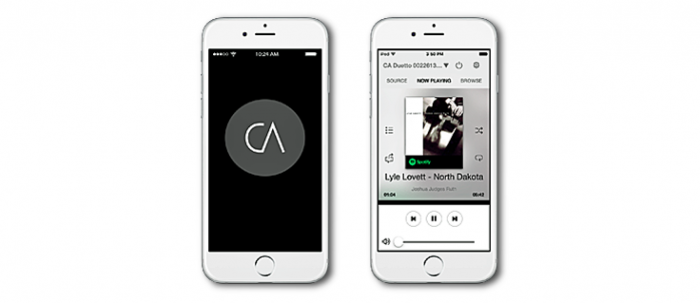
Featuring high fidelity sound and a gorgeous wooden cabinet, the Como Audio Solo Speaker will add a touch of class and elegance to your workspace. It has crisp and bold sound quality due to its custom Digital Signal Processor, a 30 watts per channel Class D digital amplifier, and 3 inputs that support the playback of hi res files. Entrepreneurs will also love the chic color display that shows the Artist/Song and a clock with dual alarms.

“Today, music is everywhere through so many content sources and the list keeps expanding and evolving,” says Tom DeVesto, Como Audio Founder and Designer. “I wanted to make it easy to access all of the music content available through one device that would deliver robust, true high-fidelity sound in a compact wooden design that would not only produce great room-filling sound, but have the ability to sync music throughout the house.”

Individual presets can also be saved so you can immediately go back to music from Spotify Connect, an aux cord, and more. Near Field Communication makes Bluetooth technology a breeze and the speaker also has a traditional remote, a USB input to play music from a flash drive (or it can charge a phone), an optical input to connect to your TV, and an internal switching power supply that automatically detects the correct input voltage.

The free Como Control App for iOS and Android also converts your smart device into a wireless, touch screen controller for your Solo or Duetto. This versatile, multi-tasking innovation works just as hard as you do and will help you create an office space you will love. It is available with either a walnut, hickory or gloss white or black finish and retails for $299+ on Amazon and comoaudio.com.

Contact: shannahch@gmail.com

The post Make Your Home Office More Exciting & Inspiring with the Multifunctional Como Audio Solo Speaker appeared first on Home Business Magazine.


from Home Business Magazine https://ift.tt/2snFvCz
via IFTTT

E-mail has remained the most popular tool for business communications for several decades. There is no surprise there. Email services are easy and convenient to use; they can store lots of information and help you stay in touch with people 24 hours a day. What is more, apart from the ordinary “send/receive email” functions, modern services allow their users to create tasks, set up reminders, and manage their calendars, which greatly simplifies the working process.

All these benefits explain why an e-mail service is an essential tool for any business today. And just as a modern businessperson needs to always be in communication to not miss an important call, in the current realities, it is critical to respond promptly to an email. The amounts of data transmitted over the online network often reaches tens to hundreds of megabytes, or even gigabytes. Some of these messages can contain extremely important information and tasks that you need to perform. Therefore, when it comes to transferring live mail to Outlook with the ability to view source it is crucial to use trusted services so you do not lose any important piece of data.

Key Features of Email Transfer Tools

There can be many reasons explaining why people may need to enact an email data transfer. Email is vital for ecommerce business owners looking to build contacts and saving the information in a safe place is smart. Someone may have switched to a different email address; some people may want to have a backup copy of crucial info. Whatever the reason is, exporting your contacts and email data is never superfluous. This is a simple and quick operation, which in the long run will help you a lot.

If you are thinking about doing an email files transmit, Live Mail to Outlook Transfer is a great tool for you to consider. It is an ideal apparatus for users who are searching for a solution to converting EML to PST. Easy use, extended functions, and lots of transfer opportunities are guaranteed. Among the main key features of the tool are the following ones:

  • Email encoding conversion;
  • Email storage support (regardless of its size);
  • EML email file import (to both standalone PST file and Outlook profile);
  • Intuitive interface;
  • Support of all Outlook versions.

On top of that, Live Mail to Outlook Transfer is a cost-effective solution since it is not necessary to buy a subscription to use the tool. It is simply enough to pay just once based on the amount of converted data. You will be asked to pay $4.96 for 1 gigabyte of processed information. Live Mail to Outlook Transfer is good to use for managing any amounts of info; you can transfer even 10-20 gigabytes of data at a time. Keep all your email files in a safe place with Live Mail to Outlook Transfer.

The post Live Email to Outlook Transfer – Features & Benefits appeared first on Home Business Magazine.


from Home Business Magazine https://ift.tt/2J4cz8R
via IFTTT

Branding is considered to be among the top aspects when it comes to setting up a business. Regardless of the size of the business, a company’s image has to look, sound, and feel unique as we live in a world swallowed by consumerism where consumers are king!

Excellent branding can catapult companies toward success.

Simply put, an image that says a lot of things even when used in an advertisement with just a single word added as the caption can make it more identifiable.

This cliché is true: “Simple means more”. Therefore, the less intricate the design is the better for consumers to remember the product. Get the gist?

How to Draft a Unique Brand

A brand tells your consumers what to expect either from your services offered or products sold. This will become your image—the thing that mirrors who you are, your aspirations, and most likely, how you want others to perceive your company.

Creating a brand involves a whole lot of thinking and may not only be drafted by one person alone but by a group of people with different ideas.

Here are steps you can take:

1. Gather your ideas. Of course, by the time you want to enter the world of business, you may already have an idea on what to sell, right?

2. Gather a team. These persons may or may not have the same ideas as you do but can provide valuable inputs. Remember: A variety of ideas can produce more options during brainstorming sessions.

3. Adopt some skills. Invite people with skills you lack so as to cover up gray areas.

4. Be open for suggestions. This gives way to a more relaxed atmosphere. Artists should not be bound by chains and the same applies for your team.

5. Look at your purse. Are you willing to spend? Business startups shell out money for operations just as those who are just expanding their companies. Ask yourself how much you can spend.

6. Cash in on a marketing approach. After you have decided on which image you want to use for your company, the next step you should take is marketing your brand. This is another expense on your part but it is likely that a good marketing strategy can push your brand towards more visibility.

Your brand, which covers copyright, trademark, patent, and most of all trade secrets, is protected by the intellectual property law.

4 Intellectual Property Categories Explained

  • Copyright – This legal right is created by a particular country’s law and awards exclusive right to the person who created the original work.
  • Patent – Patents are sets of exclusive rights granted by an intergovernmental organization or a sovereign state to inventors or assignees. It can work just for a limited period in return for making public the details of a specific invention.
  • Trade Secrets – This refers to the formula, pattern, design or process, and can even be secretly compiled information used by a business in order to obtain economic advantage or growth. Some jurisdictions refer to a trade secret as confidential information.

How to Prevent Intellectual Property Infringement

Intellectual property refers to original inventions, work, and discoveries made by an individual, a group or any legal entity. Intellectual property law protects intellectual properties and other similar versions of these original works can be considered as infringement.

There are penalties that await perpetrators of intellectual property infringement. These penalties may or may not include:

  • Punitive damages
  • Lost profits
  • Statutory damages
  • Criminal fines
  • Confiscation of copied goods

As a protection, a copyright, trademark, or a patent is obtained by the original owner of ideas. However, there are instances when a company owner commissions someone to create an original branding image. An agreement is signed by the creator or inventor to waive his right over a particular branding design or work.

In some cases, a licensing agreement is drafted to give way to a temporary use of an intellectual property. People who aim to use a copyrighted work for education, research or news can be granted by the copyright owner as long as they declare that they don’t own the rights to the work.

Furthermore, protecting a brand or a company image can have more guarantees against infringement if there is an intellectual property lawyer that works close by.

The post How to Create Your Brand and Guard It Against Intellectual Property Infringement appeared first on Home Business Magazine.


from Home Business Magazine https://ift.tt/2snFn63
via IFTTT

Know us

Our Team

Tags

Video of the Day

Contact us

Имя

Электронная почта *

Сообщение *